Supreme Court Ruling on Delhi Riots Bail Pleas
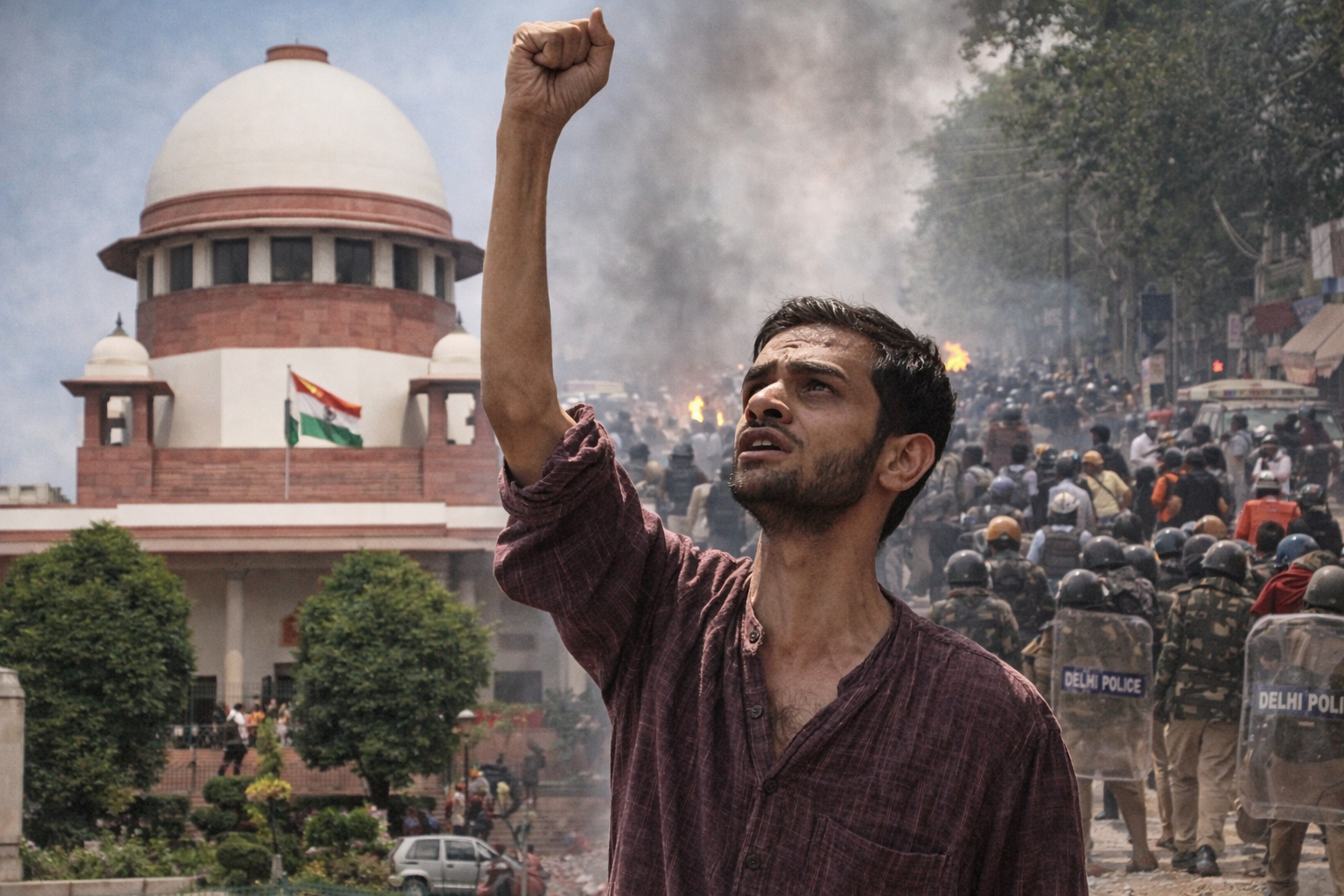
The Supreme Court of India on Monday refused to grant bail to activists Umar Khalid and Sharjeel Imam in the larger conspiracy case linked to the February 2020 Delhi riots.
At the same time, the court granted bail to five other accused, holding that all those charged do not stand on the same footing.
A bench comprising Justices Aravind Kumar and NV Anjaria said there was a prima facie case against Khalid and Imam under the Unlawful Activities (Prevention) Act (UAPA).
Both will remain in judicial custody for now.
Bail Granted to Five Accused
The court granted bail to activists Gulfisha Fatima, Meeran Haider, Shifa Ur Rehman, Mohd. Saleem Khan and Shadab Ahmad.
ALSO READ: Supreme Court Puts Aravalli Protection Orders on Hold, Goes For Fresh Expert Review
While allowing their release, the bench imposed 12 strict conditions and warned that misuse of liberty would lead to cancellation of bail.
The trial court was also directed to expedite the proceedings. The Supreme Court stressed that each bail plea must be assessed on its own merits.
‘Hierarchy of Participation’ Key to Decision
The bench underlined the concept of “hierarchy of participation” while deciding the case. It said the prosecution material showed that Khalid and Imam were placed on a qualitatively different footing compared to the other accused.
According to the court, the case records revealed a prima facie “central and formative role” played by Khalid and Imam.
Their alleged involvement went beyond local or episodic acts and extended to planning, mobilisation and strategic direction.
“All the appellants do not stand on equal footing as regards culpability,” the court observed.
Liberty and Limits Under UAPA
The Supreme Court clarified that delay in trial cannot be used as a “trump card” to override statutory safeguards under the UAPA. At the same time, it noted that bail in UAPA cases is not barred as a matter of rule.
The bench said the right to personal liberty under Article 21 of the Constitution requires the State to justify prolonged pre-trial detention.
However, in the present case, the court found sufficient material at this stage to deny bail to Khalid and Imam.
The two activists were given liberty to file fresh bail pleas after the examination of protected witnesses or after one year.
Background of the 2020 Delhi Riots Case
The violence in northeast Delhi in February 2020 left 53 people dead and more than 700 injured. The riots took place amid protests against the Citizenship (Amendment) Act (CAA) and the proposed National Register of Citizens (NRC).
Delhi Police has alleged that the riots were not spontaneous. It claimed they were the result of a pre-planned conspiracy aimed at destabilising public order.
All seven accused were booked under stringent provisions of the UAPA and sections of the Indian Penal Code. They were described by the prosecution as “masterminds” of the violence.
Arrests and Allegations
Sharjeel Imam was first arrested on January 28, 2020, for speeches delivered during anti-CAA protests. He was later arrested in August 2020 in the larger conspiracy case.
Umar Khalid was arrested on September 13, 2020. Police alleged that Khalid deliberately left Delhi before the riots to evade responsibility.
The prosecution argued that in a conspiracy, each participant is liable for the acts of others. It claimed Imam’s speeches could be attributed to Khalid and vice versa.
Arguments Before the Court
The Supreme Court heard detailed arguments from both sides. The Delhi Police was represented by Solicitor General Tushar Mehta and Additional Solicitor General S V Raju.
Senior advocates Kapil Sibal, Abhishek Singhvi, Siddhartha Dave, Salman Khurshid and Sidharth Luthra appeared for the accused.
Opposing the bail pleas, police lawyers said the riots were an attack on India’s sovereignty. The defence countered that speeches alone cannot amount to criminal conspiracy.
Verdict Reserved, Then Delivered
The top court had reserved its verdict on December 10 after hearing arguments over multiple days. The accused had challenged a September 2 order of the Delhi High Court, which had earlier denied them bail.
In its ruling, the Supreme Court made it clear that while some accused deserved bail, others did not, based on their alleged roles.
The case will now proceed before the trial court, with strict monitoring of conditions imposed on those released.
ALSO READ: Supreme Court Halts Delhi HC Bail Relief to Kuldeep Sengar in Unnao Rape Case