This IIT–IIM Alumnus Left His Job to Heal India’s Broken Farmlands
As climate change tightens its grip on agriculture and food security emerges as a global concern, one man chose to step away from corporate comfort to work with the land itself. Sandeep, an IIT Kanpur and IIM Lucknow alumnus, left behind a stable multinational career to address India’s deepening agrarian crisis. His journey from economic research to restoring forests through food production reflects a powerful idea that farming, ecology and livelihoods can thrive together when nature is allowed to lead.
In 2006, Sandeep returned to India from the United States after years of academic and professional exposure abroad. An alumnus of IIT Kanpur and IIM Lucknow, he was employed with a multinational company where part of his responsibility involved studying the Indian economy. What began as desk research soon turned into an eye-opening journey into the realities of rural India.
As Sandeep delved deeper into data and field reports, a disturbing pattern emerged. Across the country, forests were shrinking rapidly in the name of development. Groundwater levels were falling at alarming rates. With declining green cover, the impacts of climate change were becoming increasingly visible. Rainfall patterns turned erratic, temperatures rose unpredictably, and crop failures became more frequent. The worst sufferers, he observed, were farmers.
Beyond environmental damage, another crisis was taking shape. Food demand was rising steadily with a growing population, while land available for cultivation was steadily decreasing. To Sandeep, the signs of an impending food crisis were impossible to ignore.
The Decision to Walk Away from Stability
The growing imbalance between food supply and demand deeply troubled Sandeep. He felt that unless agriculture and ecology were addressed together, short-term fixes would only delay a larger collapse. The idea of continuing in a comfortable corporate role while ignoring this reality became increasingly difficult.
In 2007, Sandeep made a bold decision. He quit his job and chose to dedicate himself fully to finding a sustainable solution to India’s agrarian crisis. This decision marked the birth of Aranyaani, an initiative driven by the belief that food production could coexist with ecological restoration.
For nearly two years, Sandeep travelled extensively across India. He studied ecological conditions, soil health, rainfall cycles and land-use patterns in different regions. His goal was not to impose a new farming system but to rediscover models that worked in harmony with nature.
Discovering the Concept of Food Forests
During his research, Sandeep came across the concept of food forests. These systems mimic natural forests and are designed to produce food without exploiting resources. Unlike conventional farming, food forests do not rely on intensive human intervention, chemical inputs or heavy machinery.
What fascinated Sandeep was the idea that even existing forests could be partially restructured to allow food production without disturbing ecological balance. As he travelled through interior regions of Madhya Pradesh, he encountered vast rocky stretches of land rendered barren due to mining. These lands, he realised, were once thriving forests.
Instead of viewing them as lost causes, Sandeep saw an opportunity. He decided to take on the challenge of converting these degraded lands into productive food forests capable of producing high-quality food while restoring ecosystems.
Building a Forest That Feeds People
Sandeep explains that food forests are built in layers, much like natural ecosystems. At the centre of the land, hardy trees such as banyan and peepal are planted. These trees form the backbone of the system and help stabilise the soil and microclimate.
Surrounding these central trees, fruit-bearing varieties are planted. Between the large trees and fruit plants, vegetable shrubs and bushes are introduced. On the outer edges, lentils and legumes are grown. While shrubs are often removed in conventional farming, they play a vital role in food forests by regulating temperature and trapping moisture for young roots.
Another crucial difference lies in seed sowing. The soil is not tilled. Seeds are wrapped in a mix of soil and manure before being sown directly into the land. This method preserves the nitrogen cycle and maintains long-term soil fertility.
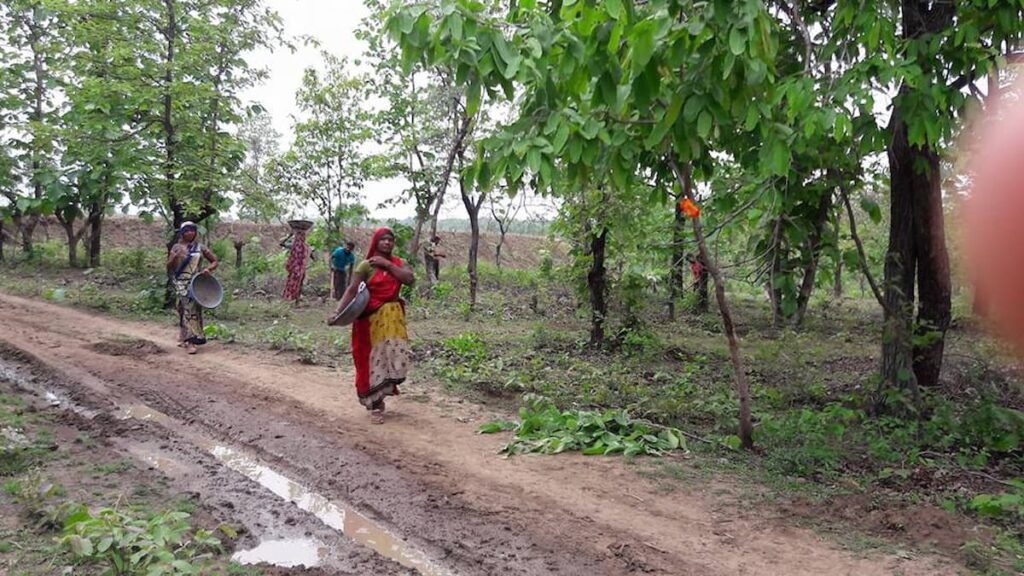
In 2012, Sandeep put this model to test on his own 100-acre farm in Sohagpur. After the first year, hardy plants established their roots. In subsequent monsoons, additional layers were added. Medicinal plants such as vetiver, neem and moringa were also introduced to strengthen biodiversity.

When Nature Takes Control
By the fourth year, the transformation was remarkable. The once barren land had evolved into a vibrant system. Biomass layers formed naturally, helping regulate summer heat and retain moisture. Plants began supporting one another during cold winters and heavy rainfall.
Finally, the last layer was introduced, including crops like turmeric, coriander and sweet potatoes. In just four years, rocky and lifeless land had turned into a thriving food forest.
What sets this model apart is the absence of artificial inputs. High-tech machinery, chemical fertilisers, hybrid seeds and additives are deliberately avoided. Instead, nature becomes the workforce. Earthworms keep soil channels open. Bees assist with pollination. Microbes enrich the soil. Birds, insects and even snakes contribute to maintaining ecological balance.
Aranyaani soon began guiding farmers to adopt this approach. So far, more than 400 farmers across multiple villages have developed food forests on over 4,000 acres of land.
Restoring Ecosystems and Farmer Livelihoods
Developing a full-fledged food forest takes patience. It requires four to five years before the system stabilises. However, the long-term benefits are substantial. Sandeep’s forests now host more than 175 types of trees and plants. Large trees release moisture continuously, leading to the formation of small streams and improved groundwater recharge.
Flora and fauna have returned to areas once considered ecologically dead. Birds, bees and animals now find shelter within these forests. Equally important is the social impact. Farmers are directly involved in maintaining and benefiting from these systems.
Ashok, one of the farmers associated with the initiative, admits he once relied heavily on chemicals due to fear of low yields. The food forest model changed everything. Buyers now travel long distances to purchase natural produce, increasing his income by nearly ₹6,000 per acre.
Sandeep believes that in today’s agricultural system, farmers and the environment are the only ones not benefitting. Through food forests, he hopes to reverse that imbalance. Though slow to develop, these man-made forests promise lasting ecological restoration and a more secure food future.
Also Read: Delhi-NCR Chokes Under Dense Smog and Fog, Flights Disrupted as Visibility Drops to Near Zero